

Power Density, Entropy, and Human Flourishing
Why “how concentrated” your energy is determines what kind of civilization you can run
Civilization is an entropy-management machine.
Not in the poetic sense. In the literal thermodynamic sense: left alone, roads crack, pipes corrode, food rots, pathogens spread, buildings mold, supply chains drift out of tolerance, and information systems degrade. The only way we keep large-scale order—clean water, sterile hospitals, cold chains, high-precision manufacturing, modern agriculture, reliable communications—is by continuously doing work. Work requires energy, and the rate at which we can deliver that energy where it’s needed is power.
That’s why energy abundance tends to travel with prosperity: higher living standards usually mean more continuous “anti-entropy services” per person—sanitation, refrigeration, mobility, healthcare, industrial output. But the under-discussed layer is composition: two societies can deliver similar total energy services and still diverge in cost and resilience depending on whether they rely more on dense, dispatchable sources (gas/nuclear/oil-derived logistics) or more on diffuse, variable flows (wind/solar/biomass). The difference isn’t virtue—it’s system overhead: land, materials, transmission, storage, redundancy, and operational complexity. At small shares, variable renewables can be additive and economical; at high shares, maintaining reliability often requires more supporting infrastructure that acts like an “entropy tax.”
Human flourishing is cheap, reliable entropy control—and cheap reliability depends on energy density and power density.
1) Two densities that quietly run the world
Energy density (MJ/kg): how much “work potential” you can carry
This matters when energy must be stored and moved: tractors, ships, industrial feedstocks, backup power, fertilizer, logistics. Fuel energy density is the difference between a fragile supply chain and a resilient one.
Power density (W/m²): how much continuous power you can produce per unit footprint
This matters when energy must be built, scaled, and connected to the places where order is maintained—cities, industry, hospitals, water systems, data centers. Lower power density tends to mean more area and more supporting infrastructure to deliver the same reliable service.
A quick sanity note: power density depends on the boundary you draw. Are you counting just the facility fence-line, or the whole system footprint (spacing, access, reservoirs, grid tie-in)? The physics doesn’t change, but the denominator does.
2) Entropy control is about continuous, local power—where the work happens
A city is a vast anti-entropy engine:
Water is pumped, filtered, disinfected
Wastewater is treated
Food is refrigerated end-to-end
Buildings are heated/cooled/dehumidified
Hospitals sterilize and maintain controlled environments
Industry runs high-temperature processes and tight tolerances
When power flows falter, disorder shows up fast: contamination, spoilage, downtime, corrosion, backlog cascades. Entropy doesn’t pause because clouds roll in or wind output dips.
3) A compact comparison: the spatial + fuel reality of energy
Order-of-magnitude intuition:
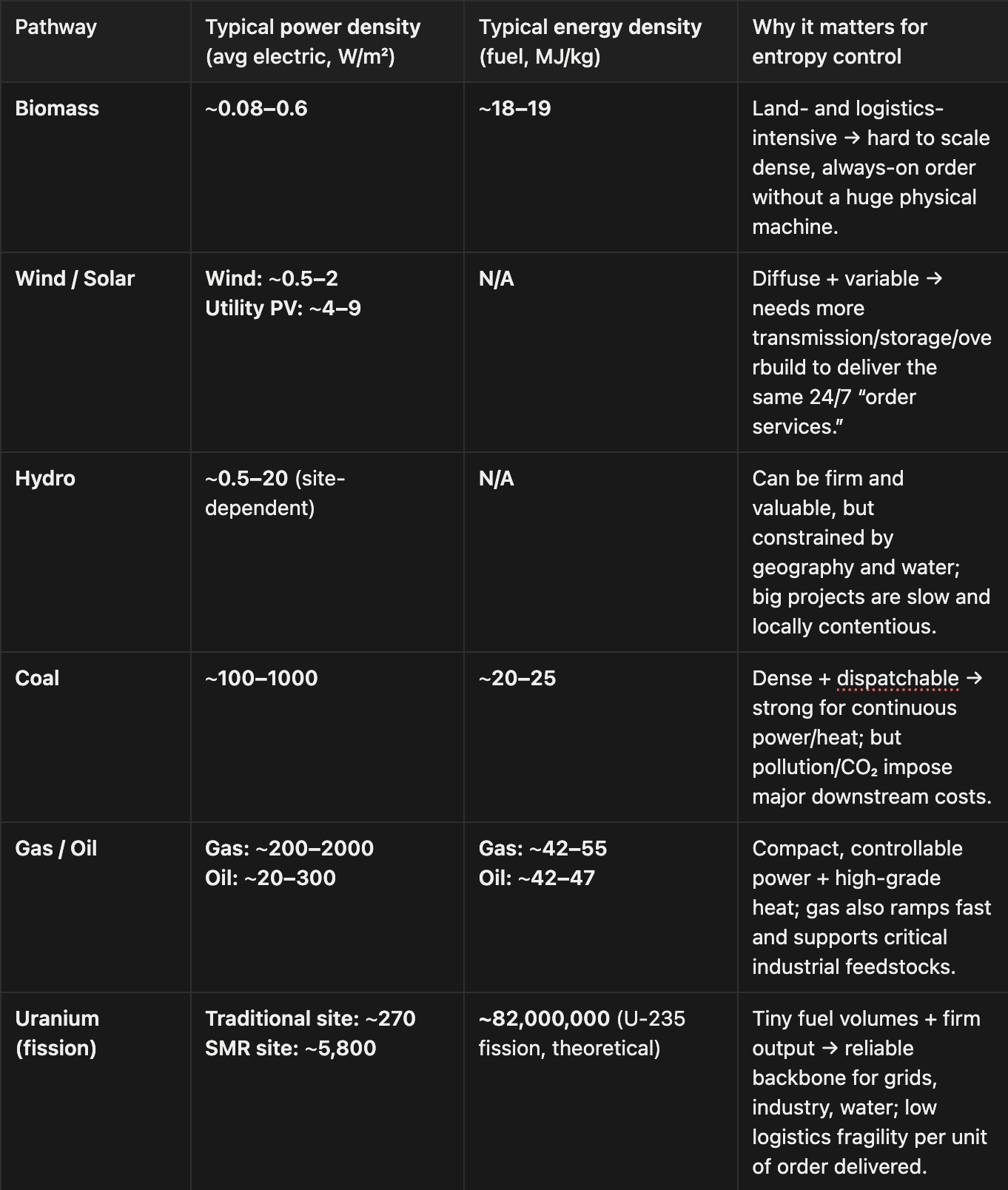
What the table is really saying (in one breath)
The pattern is stark: biomass, wind, and solar harvest diffuse flows, while coal, gas, and fission concentrate enormous power into relatively small footprints. Since modern life is essentially a 24/7 anti-entropy service, the systems that keep those services cheapest are usually the ones with firm output and high power density, backed by high fuel energy density.
Nuance: rooftop solar paired with batteries can be smart because it uses already-built surface area right on top of demand, and storage can provide local resilience and peak support. But it typically complements—not replaces—the firm, compact backbone needed to run dense cities and heavy industry around the clock.
4) Why natural gas has been an entropy-control superpower
Natural gas is not just a fuel; it’s a systems enabler because it combines:
Controllable high-temperature heat (industry, materials, chemicals)
Compact, dispatchable electricity (fast build, fast ramp, stabilizes grids)
Feedstock value (hydrogen → ammonia, methanol, industrial chemistry)
That last point is easy to underestimate. Fertilizer is an anti-entropy technology: it turns nitrogen and energy into reliable calories at scale. And cleaner household energy (gas and electricity replacing solid-fuel burning) is a direct reduction in biological disorder—less smoke, less chronic disease burden, higher human capacity.
5) Why nuclear is uniquely aligned with long-run flourishing
Nuclear’s advantage is geometric and operational:
Extreme fuel energy density → tiny fuel volumes, enormous output
Firm, high-availability electricity → supports round-the-clock order services (water, hospitals, industry)
Low air-pollution externalities relative to combustion-based systems
If your goal is to sustain modernity while reducing emissions and preserving reliability, nuclear fits the thermodynamic and spatial requirements unusually well.
6) Energy is the price of order—including security and power projection
Entropy isn’t only physical. It’s also adversarial: theft, sabotage, coercion, and instability are forms of disorder that must be deterred and contained.
“Power projection” sounds abstract until you reduce it to first principles: projecting power takes power—energy-backed logistics, industrial capacity, secure communications, mobility, and the ability to impose costs at distance. Armies are supply chains with engines; navies are floating power systems; satellites and resilience infrastructure depend on continuous energy. Better energy sources don’t just improve living standards—they increase a society’s capacity to defend order and recover from shocks.
Nature runs the same logic at its own scale. An invasive plant species overtakes parts of a forest because it captures resources more effectively—sunlight, water, nutrients—then imposes competitive costs on other species (shading them out, altering soils, changing fire regimes). In ecology and geopolitics alike, order is maintained by energy flows and the ability to make disorder expensive.
Energy abundance doesn’t guarantee virtue. But energy fragility reliably increases vulnerability to disorder.
7) Fusion: extending high-density, firm power into a new era
Fusion matters here because it targets the same civilizational lever as fission: more continuous order per unit footprint—firm power for water security, compute, industrial heat, and resilient grids without building a massive support system around diffuse primary resources.
Two commercialization pushes illustrate the direction:
Helion: publicly associated with a plan to supply electricity to Microsoft data centers, targeting delivery by 2028, and framed around a pulsed approach with a “direct electricity” ambition.
TAE + Trump Media: Trump Media & Technology Group announced a merger with TAE Technologies and stated plans—subject to approvals and closing—to site and begin construction in 2026 on an initial ~50 MWe fusion plant, with a roadmap that scales from there.
TAE’s longer-term fuel ambition is often described as hydrogen–boron (“aneutronic”), and it’s sometimes marketed in popular shorthand as “cool fusion.” The label isn’t literal (the plasma is still extremely hot); it’s signaling a cleaner reaction profile and different engineering tradeoffs than neutron-heavy mainstream paths.
If fusion can be deployed as firm, compact infrastructure, it expands what a civilization can afford: more clean water, more industrial throughput, more compute, and faster recovery from shocks—all paid for with a smaller “entropy tax” per unit of delivered order.
8) The synthesis: flourishing is the ability to keep complex order cheap
Put the pieces together:
Entropy is the background force that degrades structure and reliability.
Energy is the only tool that can locally reverse that degradation (while exporting entropy elsewhere).
Power density tells you how much continuous order you can buy per unit of physical footprint.
Energy density tells you how portable and resilient that order is when it must be stored, moved, and scaled through supply chains.
This is why energy abundance correlates with living standards—and why energy quality matters when two societies attempt the same level of modernity. If your system relies heavily on diffuse or variable primary flows, you can absolutely make it work, but you typically pay a larger entropy tax in the form of extra transmission, storage, redundancy, balancing, and materials. Those are real resources that could have gone to housing, healthcare, education, and industrial expansion.
The practical takeaway is not “one source good, one source bad.” It’s that a high-function civilization usually needs a firm, high-density backbone to keep its 24/7 anti-entropy services cheap—with diffuse sources used where they genuinely reduce overhead (for example, rooftop solar with batteries for local resilience and peak support). Historically, that backbone has been built from dense, dispatchable energy, especially natural gas and nuclear. And the reason fusion matters—if it scales as its builders intend—is that it would extend that same civilizational lever: more reliable order per unit footprint, at a level that reshapes what societies can afford to build and maintain.
In the end, prosperity is not just energy. It’s the price of order.
Love,
CookieMonster